
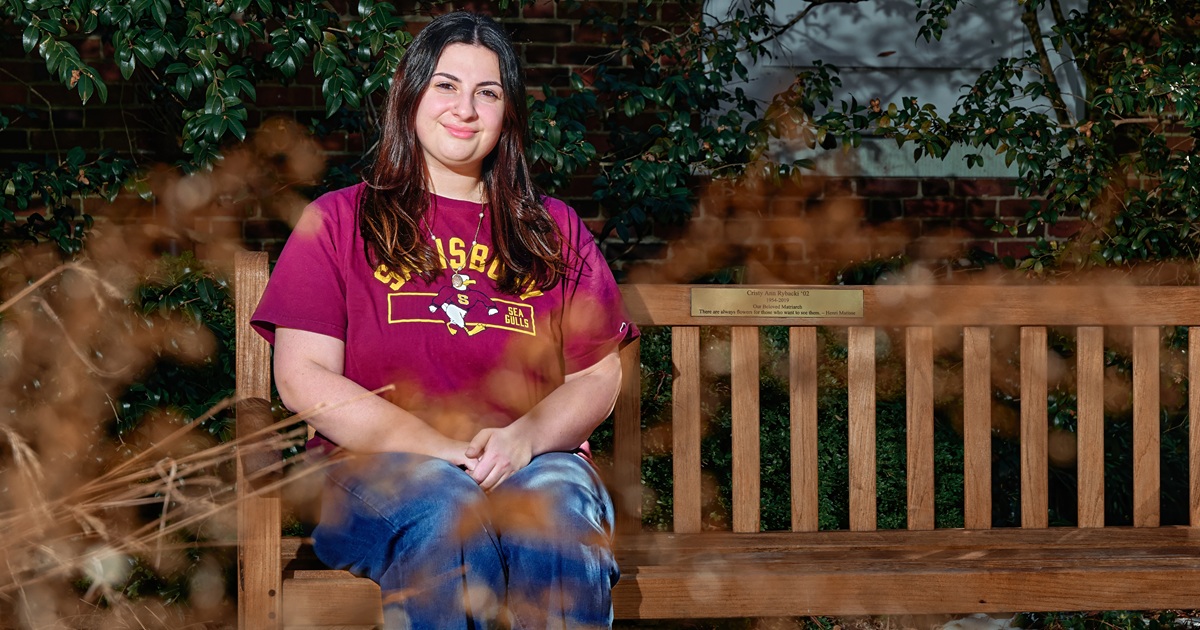
With Every Opportunity, Allison Builds a More Hopeful Tomorrow
SALISBURY, MD---Sometimes, the world can feel heavy. Allison Yeager feels that weight, too—and she knows it’s not the end of the story.
As a junior psychology major at Salisbury University, Allison studies topics that don’t come with easy answers: mental health, trauma, inequality. Yet, she remains steadfastly hopeful.
“I try to think about what could go right,” she said. “There are so many people doing so much good in the world, even when things feel uncertain.”
At SU, Allison has learned that caring deeply doesn’t mean carrying everything alone. It means showing up, challenging yourself, and trusting that even small efforts can make a real difference.
Again and again, her studies have pulled her toward the same focus: how people are supported, where systems fall short, and what happens when someone chooses to step up anyway. Whether she’s examining mental health in schools or digging into SU’s campus history, Allison approaches each project with the same intention: to understand, connect, and make space for something better.
That curiosity led her to SU’s Nabb Research Center, where students were invited to explore the archives and turn pieces of campus history into original storytelling. For Allison, it was her first real step into creative writing, and an unexpectedly personal one.
In the archives, she discovered Winifred Helmes, an SU professor during the 1970s and lifelong advocate for women’s rights. Learning about Winifred’s work—how she supported women and helped them feel connected to both the university and each other—resonated deeply.
“I’m very passionate about women’s rights and history,” Allison said. “When I learned about Winifred Helmes, the inspiration just came to me.”
In her story, Allison reflected on the fears and uncertainty many women still carry today, especially around safety, autonomy, and belonging. While she knows there is still work to be done, uncovering the legacy of women’s advocacy on the campus she calls home was grounding—proof that progress, though imperfect, is possible.
“In writing about Winifred, it felt like I was helping bring her name back,” Allison said. “It gave me so much appreciation for how far we’ve come, and it made me feel more connected to SU.”
Working closely with faculty, Allison has continued exploring how school environments can better support mental health and reduce burnout. She’s even traveled to Sicily with one of her classes and presented her research at the Eastern Psychological Association Conference in New York City—an opportunity that has shown her she has a place in these conversations, and her voice matters.
But what stands out most isn’t just what she’s studied or what she’s accomplished, but how supported she feels: professors who take time to know her, classmates who cheer her on, and a campus that encourages students to discover their own potential. In a world that often feels heavy, those moments of connection make a big difference.
For Allison, that’s where hope lives.
“I’ve surprised myself with how much I’ve done at SU,” she said. “Coming here, meeting people who are doing amazing things and believe in me, too—it makes me excited for what’s next.”