Grounded in social work values and ethics, Salisbury University offers an innovative student-centered MSW program that prepares graduates to make an impact in their local and regional communities and at national and international levels. Salisbury University MSW graduates serve as leaders in the implementation of socially just, culturally-responsive, equitable, evidence-based, and theory-informed interventions.
We will begin hosting information sessions for Fall 2028 starting in October 2027. Please check back!
What Can I Do With a Master of Social Work?
Graduates will have the skills necessary for lifelong learning and adaptation to new practice contexts. They will be prepared to work in a variety of settings in primary roles that include direct practitioners, consultants and supervisors. Students have the choice of two specializations:
Learn how work with diverse individuals, families and small groups with a special focus on interventions that enhance the person-in-environment fit and address biopsychosocial and behavioral functioning. Become prepared to work in variety of roles, including:
Learn how to work with organizations and communities to address systemic issues and to promote just and equitable social structures. Graduates assume positions in a variety of settings, including local, state and federal agencies; non-profit advocacy organizations; grassroots advocacy organizations; health and human service agencies; elected office; and political campaigns. Become prepared for careers in:
administration
policy
organizing activism
advocacy
Why Choose a Master of Social Work at Salisbury University?
The M.S.W. program at SU offers students the opportunity to earn their degree in a student-centered, supportive atmosphere. When you apply to the program at SU, you will find:
Multiple options to complete your degree. Salisbury University has five locations throughout Maryland to earn your degree! We offer our M.S.W. Program at our main campus in Salisbury and at our four regional sites in Maryland. Our campus locations are designed in a hybrid format, so students are only on campus one to two evenings per week with classes beginning at 5 p.m. and 7 p.m. Salisbury University also offers an online M.S.W. program that is completely online (asynchronous).
Field education. Students select field education placements to meet their professional goals. Current placements include a variety of settings such as community mental health agencies, child welfare agencies, county health departments and area schools.
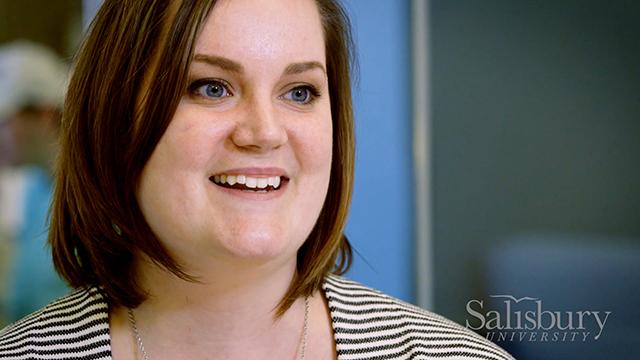
Meet Maura – M.S.W. Student
Learn how Maura is honing her skills as a social worker and giving back to her community.
Master of Social Work Program Requirements
For details on program policies as well as the program requirements, visit the University's catalog:
Loading...
Loading...
Loading...
Loading...
Campuses Across Maryland and Online
See below a list of our regional campuses and our online program.
Currently, we offer our online program in all U.S. states except California. Our online program is billed at the same tuition rate regardless of your location. At this time, you must reside within the United States to participate in our M.S.W. Program.
Courses in the Bachelor of Arts in Social Work (B.A.S.W.) and Master of Social Work (M.S.W.) programs are offered in the Kaiserslautern Military Community, Germany. Members of the U.S. Armed Forces, American employees of the U.S. government and their family members may enroll in courses through the Salisbury University/University of Maryland Global Campus Europe (UMGC Europe) partnership.
Learn More About Our Master of Social Work Program
Goal I: Perform as professional social workers in advanced direct practice with individuals, families, groups and organizations.
Goal II: Develop a professional identity grounded in social work ethics and values.
Goal III: Apply knowledge of diversity, difference, and the impact on life experiences and identity formation.
Goal IV: Demonstrate critical thinking, ongoing self- reflection and awareness of continued professional development as essential components of culturally competent advanced direct social work practice.
Goal V: Engage in scientific inquiry, evidence-based practice and program evaluation.
Goal VI: Enhance an understanding of human rights, human and community well-being, and social and economic justice.
Students coordinate their field placements with our Field Office to meet their professional goals. Traditional Program students complete two years of field practicum in two different settings; Advanced Standing Program students complete a one-year practicum in one setting.
Employment-based field placements are possible and are required to be examined by the Graduate Field Director for approval.
The BHIPP Program is a partnership between Salisbury University’s Center for Healthy Communities, University of Maryland School of Medicine, the Johns Hopkins University School of Medicine and Morgan State University, with funding from the Maryland Department of Health, Behavioral Health Administration.
The Substance Use Disorder Workforce Expansion (SUDWE) is a one-year fellowship, with grant support from the Maryland Behavioral Health Administration, for SU School of Social Work students in the specialized year of the MSW program, who are committed to working in integrated behavioral health settings.
Here are a variety of ways to help fund your education; whether it be through student loans, grants, scholarships, fellowships, or assistantships. The links on this page will help you get started with finding a source of funds that is right for you.
Phi Alpha is the National Social Work Honor Society open to undergraduate and graduate students. Members of Phi Alpha are outstanding students who are also committed to engaging in service activities that benefit the community. Learn more about the application process for membership in Phi Alpha.