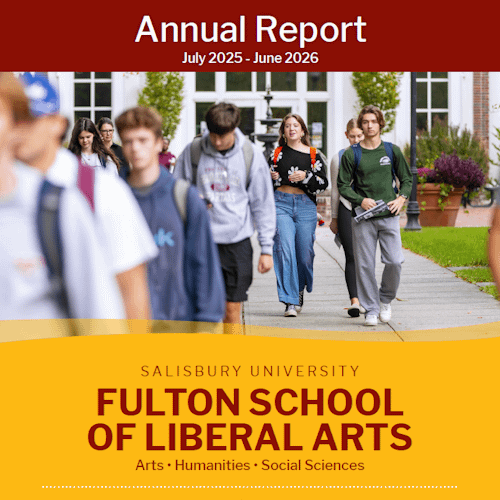
Department of Modern Languages and Intercultural Studies Annual Report
VIEW THE REPORT (PDF)
Also, check out what the Modern Languages faculty are up to!

If you want a major that helps you stand out, French or Spanish is a great choice. You’re not just learning a language, you’re training your brain and building skills you’ll use everywhere. Classes are small, interactive, and fun, with real-life assignments, not your typical classroom work. Through immersion, community engagement, and study abroad opportunities, you gain confidence speaking, cultural awareness, and practical experience giving you a strong edge for whatever comes next.
Looking to stand out, connect across cultures, and build skills that matter in a global world? Welcome to the Department of Modern Languages and Intercultural Studies at Salisbury University—a place where curiosity meets community.
Here, language learning is more than memorizing verbs. It is about becoming culturally aware, multilingual, and civically engaged. Our smaller class sizes (no more than 20 students!) and tech-enhanced classrooms offer a personalized, fun, and hands-on learning experience where you are not just a number.
Our students have the opportunity to volunteer in the community, study abroad, and lead campus initiatives that make a difference.
At every level—from beginner to advanced—you will develop critical thinking, practical communication, and a strong sense of belonging. You will also build skills like leadership, collaboration, and effective communication—valuable assets in any career field.
Learn more about the programs offered by our department:
French:
Spanish:
Intercultural Competence:
We are committed to broadening students’ worldviews by promoting global awareness and cultural understanding. As part of this mission, we offer classes in Less Commonly Taught Languages. Current options include Japanese and American Sign Language. Contact the department for information on upcoming courses.
The Department’s mission is to help students become culturally sensitive, adaptable, civically engaged, and, of course, multilingual. Our classes focus on a variety of global issues that allow students to develop practical skills that stand out in a competitive society. Our small classes and dedicated faculty foster a supportive environment and vibrant student community. Our graduates are statistically more competitive for jobs, graduate school, and Nationally Competitive Fellowship opportunities.