Scholarship
George Weide Jr. Scholarship in History - $400
This $400 scholarship(s) is awarded to an incoming or current student(s) pursuing an undergraduate degree in History, with research at The Edward H. Nabb Research Center for Delmarva History and Culture. The recipient is selected by the History Department student honors and awards committee.
Selection Criteria:
- Full-time enrollment required (12+ credits per semester)
- 3.5 minimum cumulative GPA or materials demonstrating excellence at high school (e.g., letter of recommendation, transcript, honors, etc.)
- Deadline March 1, 2026
- (Submit application through Salisbury University Academic Works or directly to the History Department administrative assistant, Melissa Hampton at mjhampton@salisbury.edu or remit to History Department, Holloway Hall 338, 1101 Camden Avenue, Salisbury, MD 21801.
Additionally, applicants must either:
- Have completed and written a research essay using resources in the Edward H. Nabb Research Center for Delmarva History & Culture.*
- Minimum 1,500 word count essay
Or
- Have developed a research proposal including a comprehensive description or the research project, list of primary sources, and detailed timeline of completion
- Minimum 400 word count outline
*Completed research papers may be submitted from past Salisbury University courses or semesters.
William H. Wroten Jr. Scholarship in History - $500
This $500 scholarship is awarded annually to a history undergraduate or graduate student who has made a significant contribution to the study of the Colonial Eastern Shore, or who has produced an exceptional work of original historical study. Established by the Class of 1959, the award recognizes the long-standing service of Dr. Wroten as Chair of the History Department. The recipient is selected by the Wroten Scholarship committee.
Selection Criteria:
- Full-time enrollment required (12+ credits per semester)
- 3.5 minimum cumulative GPA
- 500 word count essay
- Deadline: March 1, 2026
- (Submit application through Salisbury University Academic Works or directly to the History Department administrative assistant, Melissa Hampton at mjhampton@salisbury.edu or remit to History Department, Holloway Hall 338, 1101 Camden Avenue, Salisbury, MD 21801.
Awards
Wilcomb E. Washburn Student Prize in History - $500
All Salisbury University undergraduate students are invited to submit historical research papers for the Wilcomb E. Washburn Student Prize in History.
The paper must be original and based upon primary research on the Chesapeake area with special emphasis on the Delmarva Peninsula prior to 1950. Resources at the Nabb Research Center must be used in the preparation of the paper. Applicant must be an undergraduate student at Salisbury University during the calendar year preceding Honors Convocation.
Essays will be judged upon the following criteria:
Creativity • Primary Research • Literary merit • Technical form
To submit for consideration:
- Send two typed copies or e-mail research paper to the Nabb Research Center at nabbcenter@salisbury.edu or the History Department administrative assistant, Melissa Hampton at mjhampton@salisbury,edu, Holloway Hall 338, or remit to Nabb Research Center, 1101 Camden Avenue, Salisbury, MD 21801.
- Deadline: March 1, 2026
- Include cover sheet with student name, address, phone number, classification, major and mentoring professor.
Wilcomb E. Washburn Delmarva History Prize - $1500
The Edward H. Nabb Research Center for Delmarva History and Culture at Salisbury University also offers the Wilcomb E. Washburn Delmarva History Prize for outstanding historical scholarship concerning the Delmarva Peninsula. This prize is made possible through an endowment created by the W.F. Donner Foundation in honor of the late Wilcomb E. Washburn, Ph.D., a distinguished historian of the Smithsonian Institution and resident of Somerset County, MD.
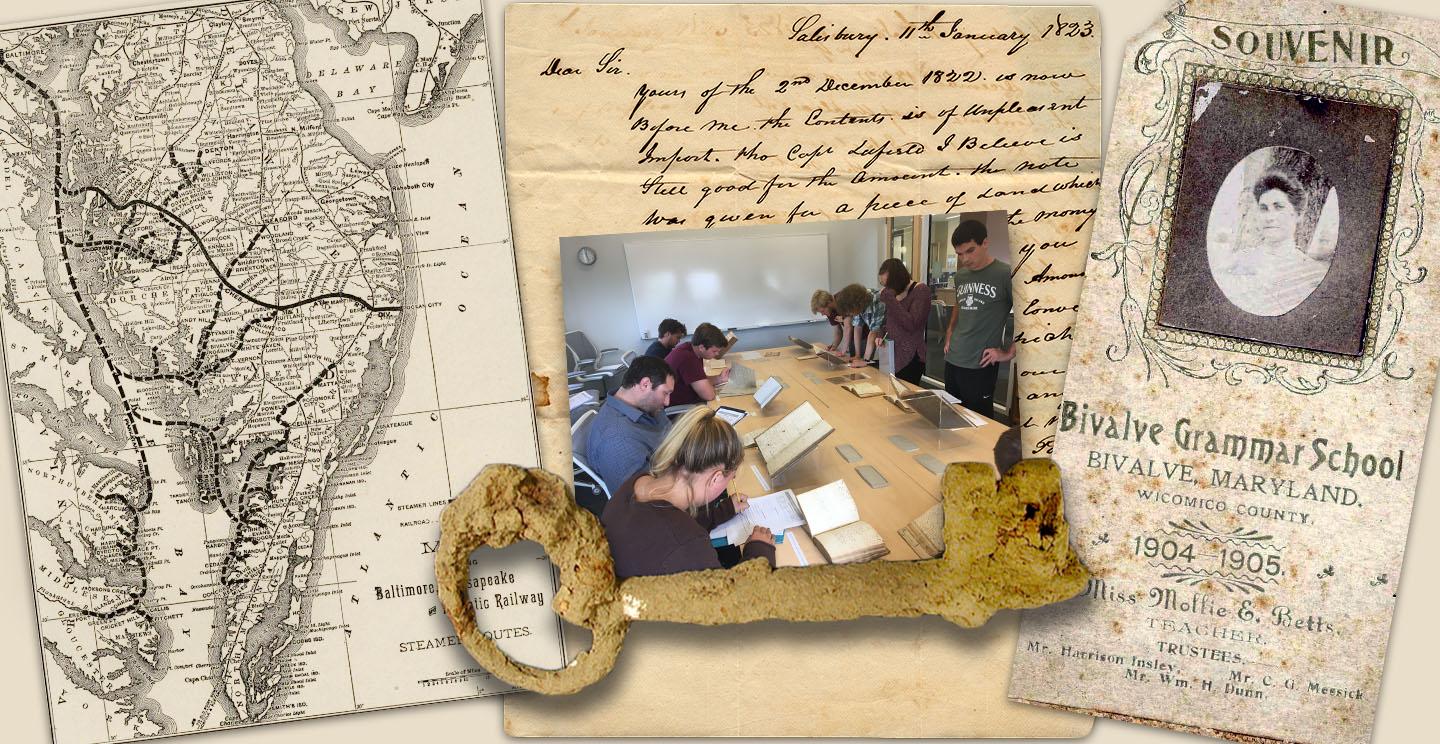
Dr. Washburn was very impressed with scholarly endeavors, in particular with primary sources and the care and preservation of original documents. Among its holdings, the Nabb Research Center holds originals and copies of the public records of the Delmarva Peninsula, the oldest continuous records in British-speaking America, going back to 1632. Dr. Washburn was quick to recognize the value of the educational nature of the Research Center which had been established.
Essays will be judged upon the following criteria:
- Any person, group of persons, organization, government agency, school (secondary or college).
- Members of the Board of Directors of the Nabb Research Center are not eligible.
- Contribution must focus on history of the Chesapeake area with special emphasis on the Delmarva Peninsula.
- Subject matter of monographs and papers must be prior to 1950.
- Applicants must display a commitment to scholarship, historical accuracy and use of primary sources.
Examples
Author of historical text, study of material culture, preservation of historic sites, re-creation of an historical event, exhibits at museums or historical societies, educational programs for students or adults, historical archeology or creation of historic districts.
To submit for consideration:
- Please include a cover letter with the following information:
- Proposed text/project to receive consideration
- Name of individual responsible, including mailing address, phone number and/or email
- Person to contact for additional information, including address, phone number and/or email
- Date you are submitting application
- Send two typed copies or e-mail research paper to the Nabb Research Center at nabbcenter@salisbury.edu or the History Department administrative assistant, Melissa Hampton at mjhampton@salisbury.edu, Holloway Hall 338, or remit to Nabb Research Center, 1101 Camden Avenue, Salisbury, MD 21801.
- Deadline: Deadline: March 1, 2026
If you are nominating an individual for the prize, please make sure to include your name, address, and telephone. Your cover letter must include your signature.
With the cover letter, submit a written report justifying why an award should be granted. Applicants are permitted to submit photos and and/or previously prepared materials when appropriate in addition to the essay. Applicants should describe the project's commitment to historical accuracy and innovation.
C. Louis “Casey” Parsons Memorial Award in History - $400
The C. Louis “Casey” Parsons Memorial Award in History will be awarded on an annual basis in the Spring to a to a graduating senior in the Fulton School of Liberal Arts at Salisbury University to recognize a student’s research contribution to the history of Maryland’s Eastern Shore, Maryland. Student must be in good standing at Salisbury University in Fulton School of Liberal Arts and must fulfill the following criteria:
- Full time student with a declared History major
- 3. 0 minimum cumulative GPA
- Has completed and written a research project on Eastern Shore history using resources in the Edward H. Nabb Research Center for Delmarva History & Culture which is approved by the Chair of the History department and the Director of the Nabb Research Center.
To submit for consideration:
- Send two typed copies or e-mail research paper to the History Department administrative assistant, Melissa Hampton at mjhampton@salisbury.edu, or remit to History Department, Holloway Hall 338, 1101 Camden Avenue, Salisbury, MD 21801.
- Deadline: Deadline: March 1, 2026
- Include cover sheet with student name, address, phone number, classification, major and mentoring professor.
*Award of the C. Louis “Casey” Parsons Memorial Award in History is a non-renewable one time award.
The Steven C. Shriver Outstanding History Student Award - $600
The Outstanding History Student Award honors an outstanding history major. History Department faculty will nominate potential honorees using the following criteria:
- Minimum 3.0 GPA in history courses
- Must be a history major
- Must have completed at least six history courses
- The department will consider both academic excellence as well as demonstrated dedication to the discipline of history though participation in internships and organizations such as the History Club (as known as Salisbury University Historical Society), etc.