Welcome to the Physics Department
The pursuit of physics is to understand and explain how nature works, from the unimaginably small world of atomic particles to the fantastically vast realm of galaxy clusters. Physicists observe nature and try to categorize and understand the phenomena they observe.
Physics is a basic science that is the foundation of many other scientific disciplines and therefore has an important impact on almost all the problems facing modern society. Many people think that physics is something new—but it started before recorded history when people first discovered recurring relationships in the environment. Through careful observation of these relationships and because of nature’s dependability, they found they could make reliable predictions that would seem to give them some control over their surroundings. Physicists solve problems and make discoveries directly through research and indirectly by teaching and inspiring others to look for explanations for the events happening in the physical universe.
The faculty’s mission is to prepare students to work confidently and effectively in physics or a related field, to develop the power to think critically, judge soundly and communicate effectively. With the assistance of physics faculty advisors, each student selects a program of theoretical and experimental courses. Students gain an understanding of the broad range of principles which characterize the discipline of physics. Additionally, students acquire the ability to apply theoretical and experimental techniques to explore a wide variety of ideas. Faculty have a personal interest in the success of students and mentor students as they progress to a degree.
Meet the Physics Department faculty and staff.
Our Academic Programs
The Physics Department offers a multi-track/concentration program of study, giving students the flexibility to pursue a challenging curriculum of inspiring courses best suited to their individual dreams and chosen career. A major in physics prepares students for careers in a variety of high-technology fields, teaching and further graduate studies in physics, engineering, medicine and other fields.
Learn more about the programs offered by our department:
- Coastal Engineering major
- Engineering Physics major
- Physics major with the following program options:
- General Physics
- Secondary Education
- Astronomy and Astrophysics
- Coastal Engineering
- Dual Degree Engineering Transfer Program
- Physics minor
- Mechanical Engineering minor
Prepare for a Career in Physics at Salisbury University
Your education matters, and the Physics Department at Salisbury University is ready to prepare you for an exceptional career. SU’s Henson School of Science and Technology offers professional facilities, dedicated faculty and undergraduate research opportunities to help college students succeed. Within the physics major, you can explore physics, engineering, astrophysics, microelectronics or secondary education. The possibilities for your future career are endless.
Look up. What's up there in the sky? Wondrous jewels – stars and planets. Promising frontiers – planets like Mars and the moon. Exciting speculations – Europa's water and black holes. Make a wish and let’s tour the universe.
Diverse Perspectives on a Unified Field
We want to have our majors complete the physics curriculum with an appreciation of physics as a unified field of study rather than a collection of unrelated courses. The classroom environment is intended to be an intellectually safe yet challenging learning space for both the faculty and student that should facilitate student learning and properly engage the student. The role of the instructor is to help a student become an independent life-long learner and to facilitate a thorough exploration of physics.
Diversity among faculty and students is not only respected but encouraged because physics is an interdisciplinary field that relies on a diverse spectrum of individuals and ideas. The Physics Department values global, societal and individual differences and has a commitment to equal opportunity.
The knowledge and skills I received from SU physics opened unbounded possibilities, landing me a world traveling position at NASA and preparing me for a master's degree.
Tracks/Concentrations in Detail
The Physics Department offers several tracks/concentrations leading toward bachelor’s degrees in physics and/or engineering – here are the details:
SU physics prepared me for my career in electronics by providing hands-on instruction in a fun atmosphere. The professors are down to earth people with top-notch expertise in their fields.
Student Resources
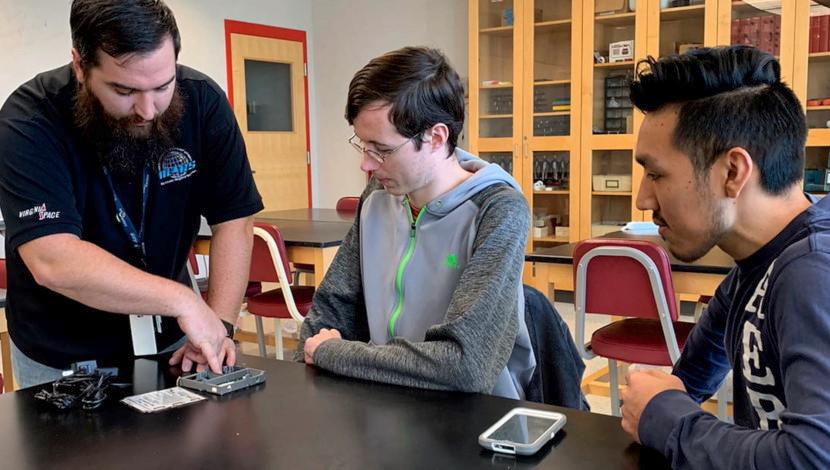
The department is relatively small, and upper-level major courses rarely have more than 15 students. We support an environment that encourages student involvement, faculty-student interaction and close student-student collaboration with a central idea that physics courses should include hands-on activities integrated with discussions and lecture. In such integrated courses, the traditional notions of lecture, laboratory, computer simulation and other classroom activities are fully blended in practice and conception and are not individual separate entities. The information provided here will help you navigate your career in SU’s Physics Department and beyond.
-
7 Tracks
-
15 Engineering Courses
-
30 + Physics Courses