Friday, September 19, 2008
Five Ways to Transform Your Resume From Ho-hum to Wow
There's no question that your resume is a vital tool in any job search. Unfortunately, some job seekers' run-of-the-mill resumes actually hurt their chances of finding the right job. If you have had the same resume for a long time and just are not getting the response you had hoped for, it might be time for a "resume makeover." Here are five resume makeover tips that might put you back on the right path.
1. Think about your target audience
A resume is nothing more an advertisement. What are you trying to sell? Yourself. The first thing advertising executives do when selling a new product is identify the target audience. When revamping your resume, this should also be your first step. Make sure each resume you send is customized to the position and the company's needs. If you are seeking a marketing position and the company has indicated it wants to hire someone with market research experience, make sure you highlight that. Make it easy for the company.
2. Make sure you have the right type of resume
There are two types of resumes: functional and chronological. While most people are familiar with chronological resumes, which include qualifications listed by past employer in reverse chronological order, you may want to consider a functional resume instead. Chronological resumes are best suited for those with a good amount of experience or individuals on a standard career path. Functional resumes highlight your abilities rather than your work history and work well for those who are re-entering the workforce, transitioning to a new field, or have frequently changed jobs.
In a functional resume, the main headlines you use are skills and strengths. For example, section headlines for someone looking to break into sales might be "Sales Experience," "Customer Service Skills," and "Managerial Skills." Under each headline, list specific accomplishments and experience from past jobs. Employment history is included in a functional resume, but at the bottom of the page and is limited to company names, job titles and employment dates.
3. Include an objective or skills summary
Like any other sales pitch, your resume needs to gain the reader's attention right away. One way to do this is by telling them who you are right away through an objective or skills summary section. This lets the reader know what you bring to the table, right up front. Consider the following statements:
Objective: To provide a targeted, creative and unique marketing vision in order to increase sales and brand awareness in major consumer markets.
Skills Summary: Highly experienced, talented and dependable sales manager with more than 10 years experience in the retail marketplace. Skilled in all aspects of retail management, including customer service, inventory control, employee management and accounting.
Both of these introductory statements set the reader up for what is to come next. Another idea to consider is following up your introduction statement with a bulleted list of skills or core competencies. Think about the skills you have gained from your experience and list those at the top of your resume.
4. Focus on accomplishments, rather than job duties
It is important to use your resume to demonstrate how you can benefit the company and illustrate how you have benefited other organizations or solved problems in the past. Include a brief one or two sentence description of your job responsibilities, but then focus on specific accomplishments. Instead of saying "wrote press releases and company materials," tout your value by telling the reader that you "developed media materials that resulted in nationwide media coverage."
5. Add some hard data
Anyone can say that they were successful at a job, but not everyone has the numbers to back up their claims. Including evidence - numbers, dollar amounts, or other hard data - will make you stand out from the crowd. Take a look at the following two resume statements:
A. Developed plan for new warehousing system that saved the company time and money.
B. Developed and implemented warehousing system that saved company more than $500,000.
Option A provides an accomplishment, but option B will gain more attention from a reader, particularly a hiring manager at a company that is interested in cutting costs.
Bottom line
With a little work and attention, your resume makeover can help you go from just another candidate to the candidate at the top of the pack!
Posted by 5
at 14:48 |
| Comments (
0
) |
Link
Friday, September 19, 2008
Tips for the Job Fair-Sept. 19, 2008
Tip 1: Preparing for the Fair
-Obtain a list from Career Services of organizations attending the Fair.
-Participate in Interviewing Workshop and review standard interviewing questions.
-Plan exactly what professional attire you will wear.
-Gather essential items to take to the fair: portfolio with notepad and pen, and more than enough copies of your resume.
Helpful Hint: Keep yourself and your materials neat and streamlined; don’t overload yourself with too much to carry.
Tip 2: Arriving at the Fair
-Check in at the registration/information table to obtain name tags (employers love them!)
-Orient yourself to the facility by ascertaining organization locations.
-Review the information which you have received and organize and prioritize a list of organizations which you plan to visit. Develop a plan.
-Check your appearance, organize all of your materials, approach the first interviewer.
Helpful Hint: If the interview line seems too long, it may be more efficient to select another organization.
Tip 3: Approaching the Interviewer
-As you approach, respect other people’s privacy as they complete their interviews.
-As you approach the interviewer, establish eye contact, present a firm handshake, introduce yourself and explain why you are interested in their organization.
-Conduct yourself professionally at all times, remembering you are on stage even as you stand in line or move about the job fair.
Helpful Hint: Avoid being one of the candidates who offers a limp handshake and waits to be grilled; be confident and be proactive.
Tip 4: Interviewing for a Position
-Know what you are looking for, what you have to offer, and what questions you will ask.
-Listen carefully and take conversational cues from the interviewer.
-Use transition statements to share information about yourself that the interviewer may not have addressed (e.g., A. That’s interesting, I had an experience which relates... or B. May I tell you about..).
-Respond truthfully, while always painting a positive picture of yourself (e.g., A. I have not yet had an opportunity to..., but in a similar situation, I...).
-Ask for information and application materials and the interviewer’s business card.
-Ask about the hiring process, its time lines, and determine actual and potential openings.
-At the end of the interaction, offer a firm handshake and express your appreciation, using the interviewer’s name.
-Walk away with confidence, remembering that you are still on stage.
Helpful Hints: Immediately following the interview, go to a quiet area and make notes on topics of conversation, contact names and follow-up procedures.
Tip 5: Following up after the Fair
- Write thank you letters, addressed to the specific interviewers (include typed application materials if you have them).
- Check with Career Services to see what employers are recruiting on campus and sign-up.
- Within ten days, make telephone calls to determine if the organizations have received your application materials, to check on the status of the vacant positions, and to express your continued interest.
Helpful Hint: Keep accurate records of your contacts, including dates of your letters or telephone calls, and copies of all application materials which you send.
Posted by 5
at 09:58 |
| Comments (
0
) |
Link
Monday, September 15, 2008
How To Dress for the SU Job/Internship Fair
There are over 70 employers registered for the 2008 SU Job/Internship Fair. One of the best ways to market yourself is dress appropriately. You MUST represent yourself well by dressing business professional or at least business casual.
Business Professional:
GUIDELINES FOR MEN:
SUIT: dark blue, gray, muted pin-stripes
SHIRT: white, pale blue, pale yellow
TIE: conservative, classic
SHOES: highly polished slip-ons or laced dress shoes; brown, cordovan, or black
GUIDELINES FOR WOMEN
SUIT, DRESS: conservative, below knee length
BLOUSE: simple style, white or soft colors
SHOES: pumps or medium heels
HOSE: beige, tan, or natural
PURSE: medium or small size in a color that goes with your outfit
MISC: clear or lightly tinted nail polish, minimal jewelry, light perfume, understated natural makeup
Business Casual Guidelines for Men and Women:
When you are specifically directed to wear business casual, or think that this attire is in order, you can follow the following guidelines.
Pants: Khaki pants, neatly pressed, and a pressed long-sleeved, buttoned solid shirt are safe business casual for both men and women.
Shirt: Polo shirts are an appropriate choice if you know the environment will be quite casual, outdoors, or in a very hot location.
Shoes/Belt: Be sure to wear a belt and shoes that are in good condition. Athletic shoes and flip flops are not acceptable.
Click here to see examples of both Business Professional and Business Casual
Specifics for Men's Business Casual:
Ties: Ties are great to wear with a sports coat. Do not wear a ties that has graphics on it that will detract from you and your conversation.
Shirts: Long-sleeved shirts are considered dressier than short-sleeved and are appropriate even in summer. Choosing white or light blue solid or conservative stripes is your safest bet. Polo shirts (tucked in, of course) are acceptable in more casual situations.
Socks: Do wear dark socks, mid-calf length so no skin is visible when you sit down.
Shoes: Shoes that are in good condition should be worn. No sandals, athletic shoes or hiking boots.
Cologne, Hair, Jewelry, Backpack: Make sure your hair is neat and well-groomed. Use very little cologne and jewelry. Do not take your backpack in to the fair. Leave it in the Career Center.
Specifics for Women's Business Casual:
Pants/Skirts: Women can wear casual pants or skirts. For the most businesslike appearance, pants should be tailored. A knee-length skirt is preferable although a long skirt may be considered.
Shirt/Sweaters/Jackets: In addition to tailored shirts or blouses, tailored knit sweaters and sweater sets are appropriate business casual choices for women. A tailored jacket may also be worn.
Shoes and Hosiery: Closed-toe shoes, sandals which are neither extremely dressy nor extremely casual are appropriate. Regardless of what is in style, avoid extreme. Make certain you can walk comfortably in your shoes. Hosiery should be considered with skirts.
Cologne, Hair, Jewelry, Backpack: Make sure your hair is neat and well-groomed. Use very little cologne and jewelry. Do not take your backpack in to the fair. Leave it in the Career Center.
The Do Not’s:
Do NOT bring your skateboard
Do not wear shorts
Do not wear a hat
Do not wear t-shirts
Do not wear sweatshirts or sweatpants
Do not chew gum
etc., etc., etc.
Dress well and be confident! You may land a job or an internship from this fair and the best way to do that is dress professionally! See you at the fair.
Charlie Endicott
Associate Director of Career Services
Salisbury University
Posted by 5
at 09:19 |
| Comments (
0
) |
Link
Friday, September 12, 2008
The SU Fall Job Fair is almost here...
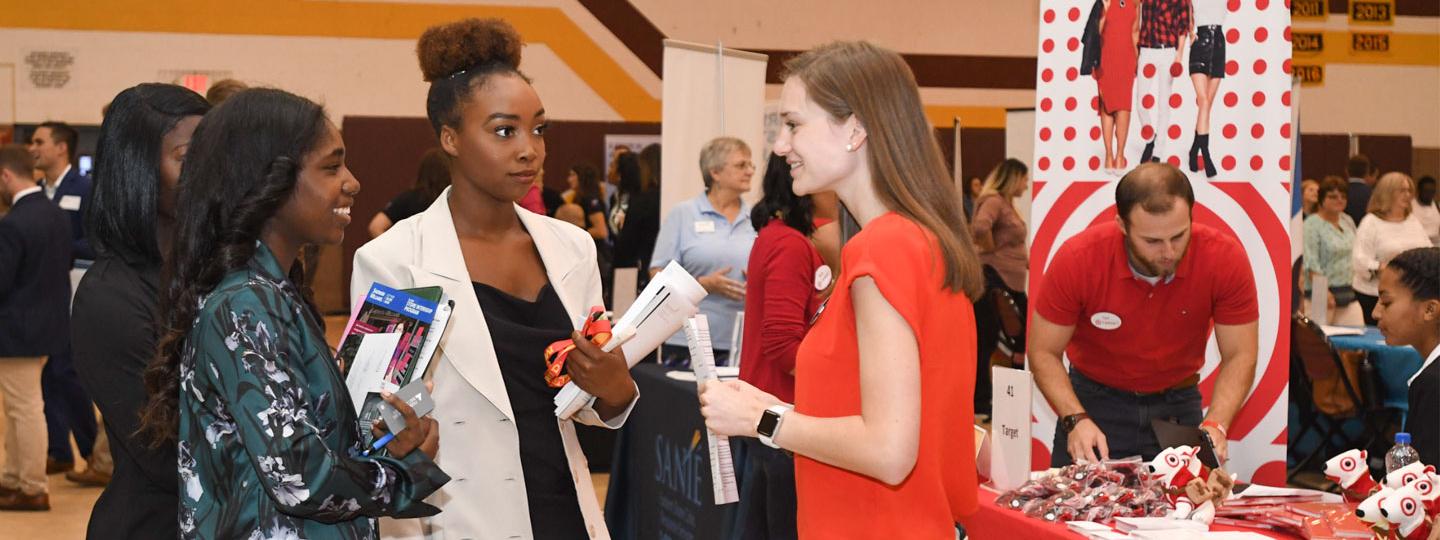
The SU Fall Job Fair is almost here and many employers (over 60) have registered. Before the fair arrives I would like to address some comments that have been made in the past. We have heard comments like "there were not enough employers at the fair" and "there were no employers for my major" and "most of the employers are from the Eastern Shore." All of these comments are taken in a constructive manner and we, SU Career Services, try to address them. First I would like to tell you what goes in to organizing a job fair and some reasons for organizations attending or not attending.
How the SU Job Fair is developed:
1. Over 1,000 employers are invited to the fair
2. Many employers invited recruit from all majors (excluding education for this particular fair)
3. The employers are located nationwide and some international
Reasons why employers do not attend:
1. They do not have the budget
2. They are not in our geographic area
3. We do not have the major they are looking for
4. They only recruit at colleges that they have historically recruited from
5. Many employees are alumni from a particular college
As you can see there are many factors that come in to play when organizing a job fair. These are not excuses-we will continue to bring as many employers to campus as we can-SU students deserve that. In my opinion, the upcoming fair has a very good representation of employers and many highly visible organizations that have openings nationwide. Take advantage of this fair and make sure you present yourself in a professional manner!
Let me hear your thoughts. More on this later.
Charlie Endicott
SU Career Services
Posted by 5
at 14:41 |
| Comments (
1
) |
Link