
Faculty Academy and Mentorship Initiative of Maryland (FAMI-MD)
 The Faculty Academy and Mentorship Initiative of Maryland (FAMI-MD), formerly known as ESFAMI, prepares experienced registered nurses who hold a bachelor’s degree or higher, for new roles as clinical nursing faculty. Funded through the Maryland Higher Education Commission Nurse Support II program, FAMI-MD is offered as a collaborative effort among nursing programs across the state of Maryland. FAMI-MD graduates teach at nearly all accredited nursing programs in Maryland, and the academies are facilitated by faculty from different Maryland schools. Nurses who participate in FAMI-MD will complete a six-week long Academy, consisting of online instruction with virtual synchronous sessions. FAMI-MD offers two curricula: an Introductory Academy that provides a foundation for new educators and an Advanced Academy that explores learning theories, learning strategies, assessment and evaluation, and professional advancement.
Interested in Applying?












What Academy Participants Will Learn
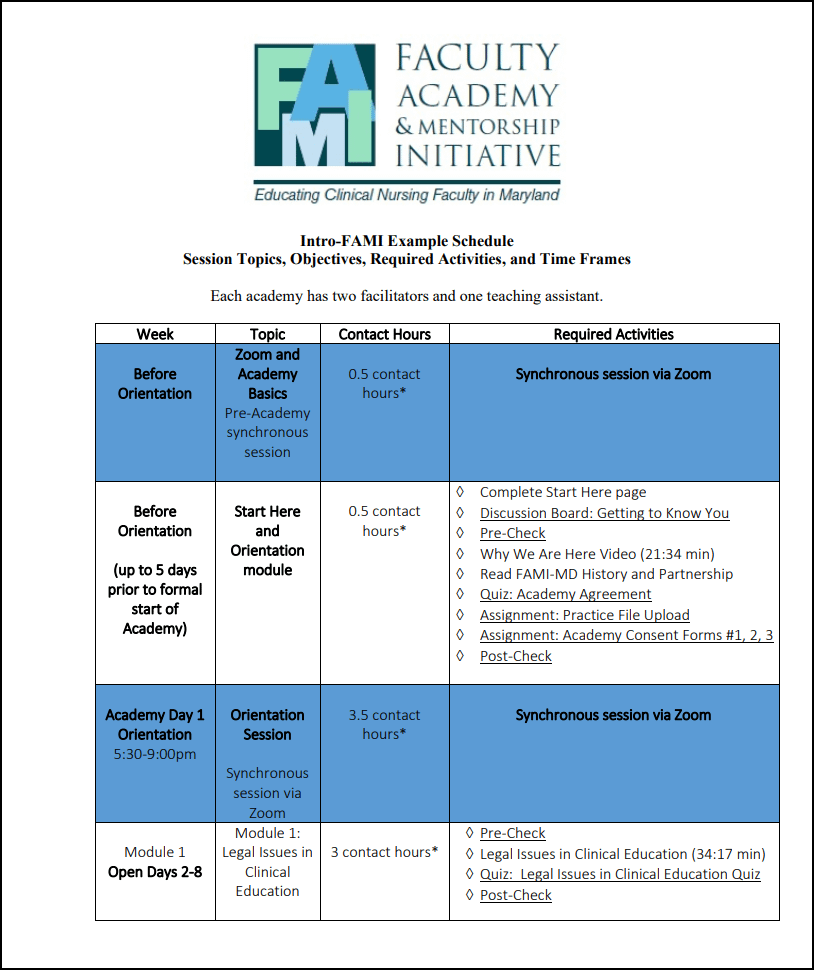
Intro-FAMI attendees learn about what is expected of clinical faculty, how to design and manage experiences in a clinical setting, and principles of evaluating student performance and providing feedback.
Specific outcomes include the ability to:
- Apply the principles of teaching/learning to various types of student learners in the clinical setting.
- Participate in on line discussions regarding aspects of teaching in the clinical setting and complete projects which involve on line activities.
- Describe the role of the part-time clinical educator in the clinical setting.
- Structure learning experiences in a clinical setting, as well as, devise an alternative plan for student clinical experience should the need arise.
- Plan and implement valuable pre-clinical and post-clinical experiences and conferences.
- Provide constructive feedback to nursing students in a clinical setting.
- Implement strategies to manage challenging students in a clinical setting.
- Participate in discussion groups about their teaching experiences during mentorship workshops.
- Participate in high fidelity simulated patient care experiences and assess performance of both students and faculty in the simulated setting.
- Discuss potential legal implications of role as a clinical educator.
- Integrate current evidence into clinical teaching practice.
Advanced-FAMI attendees will learn how to:
- Apply key elements of nursing and academic regulations and laws to the clinical educator role.
- Synthesize perspectives from various learning theories to formulate strategies to reach today’s learners.
- Develop effective teaching strategies to address learning in the affective, cognitive, and psychomotor domains.
- Formulate goals and strategies that promote active and engaged learning in face-face and online settings.
- Explain strategies that can be used to foster student success related to inclusivity, recognizing limitations, and providing development opportunities
- Differentiate clinical objectives from student learning outcomes and connect clinical objectives with learning strategies.
- Integrate synchronous and asynchronous strategies to support the teaching-learning process in an online environment.
- Demonstrate skill in the use of best practices in the assessment and evaluation of clinical performance.
- Explore aspects of professional development as a faculty member including certifications, advanced degrees, and other activities.
Our Achievements
Since FAMI’s inception in 2011, we have graduated 684 nurses. For the period of July 2020 – June 2025, FAMI-MD has graduated 483 nurses, including 50% from under-represented groups in nursing. Thirty-four percent (n=162) of FAMI-MD graduates teach in a high need specialty area, such as community health, maternity, mental health, or pediatrics.
The outcomes of FAMI-MD have presented at multiple regional, national, and international conferences, and through multiple publications. In 2023 the program was the recipient of the inaugural National League for Nursing Peg E. Daw Certification Star Award and in 2015 received the Sigma Theta Tau International for the Excellence in Nursing Education Research Award.
For the period of July 2020 – June 2025, 73% (n=351) of FAMI-MD graduates were currently teaching or have taken a teaching position in the state of Maryland. 15% (n=71) of FAMI-MD graduates hold certifications as Certified Nurse Educators through the NLN.
FAMI-Maryland is supported by a Nurse Support II Grant from the Maryland Higher Education Commission under the auspices of the State of Maryland Health Services Cost Review Commission.
Frequently Asked Questions about FAMI-MD
- 1. How is the FAMI-MD program laid out? Are there assignments and due dates?
- 2. How much time is required of me besides the synchronous FAMI-MD sessions?
- 3. What if I have to miss one of the synchronous sessions?
- 4. What topics are covered in Introductory-FAMI? What topics are covered in Advanced- FAMI?
- 5. Who are the facilitators?
- 6. I've never taught before. Can I still take FAMI-MD?
- 7. What is the FAMI-MD teaching commitment? Does it add to my Cohen Scholars teaching commitment?
- 8. Will FAMI-MD hire me for a teaching position? Can FAMI-MD help me get a job?
- 9. Do I still get a stipend and 40 contact hours as a Cohen Scholar?
- 10. What if I have other questions? Who can I talk to? Is there a website with more information?